Showing posts with label Venice. Show all posts

Wednesday, April 26, 2017

Art to See in Venice

All those who enter Damien Hirst's latest exhibition in Venice, you'd better believe it! 

Damien Hirst is one of the most famous and richest living artists, whose career began in the 90s and since then, he has never stopped baffling the world of contemporary art with his daring exhibitions and takes on life and death. Named "the bad boy" of British art, he has been quiet for the past decade but that was because he has been working on his newest presentation which opened in Venice on the 9th of April and will last until 3rd December. 


"Treasures from the Wreck of the Unbelievable" is so enormous that it actually occupies two locations: Palazzo Grassi and Punta della Dogana, buildings own by the billionaire, art collector and Christie's owner Francois Pinault. 

The bold exhibition presents a sea fantasy at a fantastical scale and it even comes with a back story: the objects presented, 189 of them, come from a ship that sank 2,000 years ago. They are made of different materials, ranging from marble to silver, "belonging" to Greek, Aztec, Roman, Japanese or contemporary culture. Hirst's team even filmed this discoveries to make everything believable but, the ambiguity is always there when you look at the objects: are they more than 2,000 years old, being covered with corals, or were they created just a few years ago? 

The most impressive piece of work is his 18 meter high black statue "Demon with Bowl" that has you wonder how anyone would manage to get it inside the building. 

Even if people seem to either love or hate his exhibitions, I can truly say it was a privilege to see this incredible presentation of a genius who makes you believe the unbelievable and who has spent millions of dollars from his own pocket to do just that... until his collection is auctioned next year :) 


Sunday, February 7, 2016

Brunetti's Venice

"Venice is a complicated place, physically and spiritually, and it is extraordinarily difficult to establish Venetian facts. Nothing is ever quite certain." (Jan Morris, Venice) 

If you love Venice, then I am sure you are familiar with Donna Leon's series set in the magic city and whose main character is Commissario Brunetti. I have read a few of her books with the intention of definitely reading some more, but a few weeks ago I came across this book, "Brunetti's Venice" and I had to leaf though it, since you cannot actually read it. You have to be in Venice to track Brunetti's walks, his favorite places, the churches he passes by, his stops at different cafes and his home. The book presents such an accurate description of his wanderings that you cannot but wish to discover Venice, book in hand, the way that Toni Sepeda, the professor of literature who compiled these walking tours envisaged for you. Each chapter takes us on a different tour, and the sights are blended with passages from Donna Leon's books (pictured above), in order to support and clarify the character's endeavors. At the end of each walk you can also find info on additional sites and details as well as the time the walk may take.

"He wondered what divine intercession could save the city from the oil slick, this modern plague that covered the waters of the laguna and had already destroyed millions of the crabs that had crawled though the nightmares of his childhood. What Redeemer could come and save the city from the pall of greenish smoke that was slowly turning marble to meringue? A man of limited faith, he could imagine no salvation, either divine or human." (Death at la Fenice, chapter 14) 

So, next time you visit Venice, try to exchange your ordinary tour book with this fascinating account and you will be seeing Venice though the eyes of a famous character. And when you return home, why not try some of the recipes from "Brunetti's Cookbook" as well? :)

Monday, February 1, 2016

Venice in February... Again


I have no intention of giving up on my other challenge, which turns 4 today, mainly because Venice is still my favorite city in the world and I can't wait to rediscover it though fantastic literature. I have in mind quite a lot of books, but I will definitely read these two: "La Tempestad" written in 1997 by Juan Manuel de Prada, translated into Romanian a few years ago, and which seems to present a totally different image of the Venice we may know, and the long awaited "Venice Noir", a selection of 14 stories set in Venice, which range from the ones depicting tourists during Carnevale to criminals trying to elude the law.... These two tomes should be quite intriguing, to say the least!

Do join me this month in my quest for the mysterious Venice! 

Sunday, March 1, 2015

A Famous Venetian


"Venice makes you feel like you can dare anything." 

Veronica Franco has been known for centuries as the famous Venetian courtesan who shared intimacies with emperors, those who ruled Venice in the 16th century, whether it was due to their political power or money. However, in her book "Honorata Cortigiana" the Italian writer Rosa Ventrella, manages to go beyond the infamous person to expose a woman in love with poetry and aspiring to a higher lever of beauty, love and life. It somehow reminded me of the main character from the movie "Moulin Rouge", the courtesan Satin, played wonderfully by Nicole Kidman.

"She possessed a more wicked gift than money: she knew how to read in men's eyes unutterable desires. And she was willing to turn them into reality." 

Back to the book, we discover Veronica as a teenager, before her mother convinced her to follow in her footsteps and become a courtesan herself, then we see her struggle in an unsatisfying marriage with an old but rich man who is aware of her sexual needs that she is trying to fulfill by turning into the most desired courtesan of that time in Venice to finally giving everything up - fame, fortune and even freedom -to be together with the man that she loves.

"The pain of living was tearing her heart."

Veronica was truly a powerful woman and a visionary, beyond that flaws that some of us may see in her character. Her wish to spend her fortune on building a shelter for former courtesans is something to appreciate her for, together with the honesty that she shows in her final years. A wonderful book to read in order to discover a world long gone yet still vivid in the writer's imagination. And ours.

Tuesday, February 25, 2014

I Won't Let Go of My Dreams!

Life is about accomplishing your dreams and desires, no matter how foolish or daring they may seem for those around you...


What a fantastic experience Venice in February was, with so many places discovered for the first time, with others bringing up beautiful memories. Venice is more than words could describe and the moment I left, I wanted to go back and soak into its mist, touristy atmosphere, fun and mystery.

Here are a few glimpses of my time in Venice, wishing for more trips in the near or far away future :)

Friday, February 7, 2014

My Venice in February

 If you read this then know I am in the land of too much beauty, mystery and everything fairy tale-like. This year I have taken my Reading Challenge, Venice in February, a little bit further, actually, 1,000 km away, so I will not only be reading about Venice but I will also experience it through its famous museums and landmarks, wintery strolls,  and hot chocolates :) Bookwise, my first Donna Leon will be enjoyed, mainly while expecting for the flight to take off/land, and when I get back, the mystery surrounding Venice will still be present through  Delalande's "The Dante Trap".

If time allows it, I will be indulging in finishing "When God Was a Rabbit" for the reading club I coordinate at school and some personal thoughts written down by the Romanian actor, musician and creative mind, Tudor Chirila.

Follow your dreams!

Monday, November 18, 2013

Morgan Sparkles

Another week, another creative task for "The Future of Storytelling" course. This time, we have been asked to create our own character, attributing as many features to him/her as we can imagine. In my case, I have always admired Villanelle from Jeanette Winterson's "Passion", so Morgan is somehow related to her, a step sister, let's say, whose passion is to murder her lovers with a dagger and throw them into the dark waters of Venice.

She lives in a palazzo, but no one knows where exactly, she remains a mystery for everyone around. She loves playing cards and gambling her assets and her own life, mainly because she knows there is no chance she could lose. Why? Because long time ago she was cursed to live until she would find Sublime Love, which doesn't seem to be found easily... but something tells her that there might be a chance for that in a narrow street in Venice, simply because she dreamed about meeting Sublime Love while sailing on the Venetian canals.
I also have to mention that she was born in the year of the Fire Rabbit, one day in February, a long, long time ago...

Wednesday, February 20, 2013

Ackroyd's Venice


Peter Ackroyd is an English biographer, novelist and critic whose prolific work includes books on Dickens, Shakespeare, Chaucer, but also on London, the river Thames and Venice.
His "Venice Pure City" is seen as "sumptuous" by The Times and as "brilliant" by Independent on Sunday, so there can be only one conclusion: he really knows Venice, its history and glory, its mystery and beauty.
The book is comprised of eleven chapters and a Venetian chronology and they develop topics such as how the state of Venice was formed, the empire built on trade, the city's secrets, sacredness and its shadows. the book is full of pictures ranging from old maps of Venice to the interior of the basilica of Saint Mark or Titian's paintings of Venetian personalities.

"How could they build upon mud and water? It was possible, however, for wooden poles of from ten to a dozen feet in length to be sunk into the mud before reaching a layer of harder clay and dense sand that acted as a firm foundation. This was the 'boundary' at the bottom of the lagoon. So there sprang up small houses known as casoni made from the wood of poles and boards with pitched roofs of wattle and reed. " (page 7)

Ackroyd talks about the dialect spoken in Venice, the invasions that took place centuries ago and, did you know that it was not called Venezia until the thirteenth century?
Being built upon the sea, Venice became the city of miracles and in the Venetian chronicles the city was always presented as a great and shining place.

In this fascinating account, the writer even talks about the Venice weather:
"But the most celebrated wind is the scirocco, the warm wind that comes from the south-east and can persist for three or four days. (...) The scirocco itself has been blamed for the Venetian tendency towards sensuality and indolence; it has been accused of instilling passivity and even effeminacy within the citizen." (page 29)

With almost five hundred pages, the book is a pure gem when it comes to discovering or rediscovering the Venice behind the tourist attractions and I heartily recommend it to anyone who is in love with the city. By the way, did you know that in the sixteenth century there were five hundred gardens in Venice? :)

The Guardian develops on the subject of Gardens in Venice here.

Read for my pleasure, the Venice in February and the Non - Fiction Reading Challenges

Thursday, February 14, 2013

Magical Venice

 
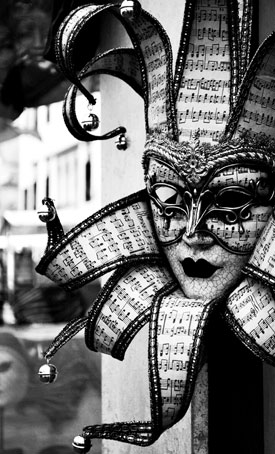
It may seem to be exclusively a place of magical excitement, but there is more to it than that. February in Venice is carnival season, where things are far from what they seem, and it is impossible to distinguish between the performers and the spectators. Revellers flit through the alleys, and ghostly masks hang from the ceilings and walls of tiny shops. it is easy to get caught up in the crowds of people who have flocked to Venice for the carnival, to munch on fritelle, small doughnuts made only during carnival season, and to forget that there is more to Venice than just entertainment...

Sunday, February 10, 2013

Vivaldi's Women

 Venice is not just about gondolas, canals, bridges and masks during the carnival... Venice also means classical music, and among the many composers that were inspired by the music of the waves and the courtesans' laughter Vivaldi, The Red Priest, is representative of what Venice means when it comes to "serious" music. There is so much more than The Four Seasons when Vivaldi's music is concerned. He spent a lot of his time, almost 40 years, writing music for the girls who were housed in La Pieta, a foundling hospital where abandoned children were brought in.
 Back in 2006, BBC 4 decided to film a documentary about the former Oxford Girls Choir, now a choir that sings and plays Vivaldi's sacred music, named Schola Pietatis Antonio Vivaldi. The women wear Venetian costumes during their performances and sing Vivaldi's compositions for his pupils back in the 18th century. Besides seeing La Pieta from a different perspective, I was really impressed by Micky White's passion of discovering the women behind Vivaldi's choir.
Watch the entire documentary here. Enjoy! 

Sunday, February 3, 2013

Snowflakes and Venice


And if this picture is not enough to make you tackle our Venice in February reading challenge, here's an interactive map of the mesmerizing city of dreams...

Sunday, January 27, 2013

In the mood for ... Venice

February comes with the Venice in February reading challenge, hosted by Bellezza and myself, and I am so looking forward to reading about Venice and rediscovering this amazing city. You can join us here, and the only rule is that you have to read at least one book Venice-related. The blog also has a long list of books about or set in Venice, so you only have to bring your mood with you... Here's what I am going to read and hopefully post about:

Peter Ackroyd's Venice, a Pure City (a non-fictional book about the city, comprising architecture and history) 
Thomas Mann's Death in Venice (a reread, together with Bellezza)
Michelle Lovric's The Book of Human Skin (set in Venice, the story seems quite good)

Also, check the blog for everything Venice - related: music, history and art. 

LET THE CARNIVAL BEGIN! :)

Wednesday, February 22, 2012

Vivaldi's Virgins


"Vivaldi's Virgins" is a daring historical novel set in the 18th century in Vivaldi's Venice. It is the story of Anna Maria Dal Violin, an orphan whose amazing voice and talent mesmerize Vivaldi, known as "The Red Priest", who starts composing just for her.
Anna Maria struggles to find the identity of the mother that abandoned her at Ospedale della Pieta, writing letters to her from the convent, without knowing if she is alive or not. These letters offer us a glimpse into the Venice of the 1700s, with its mysterious people hidden behind masks, cruel nuns, naughty girls who escape from the convent just to go to the opera and who feel enthralled just to ride in a gondola.

“The sky on a clear night is a living, pulsating thing. The stars are like musical notes turned to light, and, like notes, they shimmer and swell and fade and fall. The painters have never captured it—but they never will until some painter teaches his colors to dance.”

If you are interested in knowing if Anna Maria finally discovered who her mother was, then you must read the novel. What is more appealing is the fact that Anna Maria actually existed, and Barbara Quick spent a few weeks in Venice back in 2005 doing research on her. If you want to read more about her experience, go here.
I enjoyed the story quite a lot, since it depicted Venice in a daring way, just as I see it and it also reminded me of Sarah Dunant's "In the Company of the Courtesan", a book I simply loved.

Read for Venice in February Reading Challenge, European Reading Challenge and New Authors Challenge.

P.S. Santa Maria della Pieta is now open to accommodate pilgrims, in case you wish to visit Venice :)

Monday, February 20, 2012

Venice in Black and White


My beautiful, my own
My only Venice-this is breath! Thy breeze
Thine Adrian sea-breeze, how it fans my face!
Thy very winds feel native to my veins,
And cool them into calmness!

~ Lord Byron "The Two Foscari"

Saturday, February 18, 2012

Venice Reading Challenge - Invisible Cities

Italo Calvino's "Invisible Cities" is a poetry-in-prose book, a series of descriptions, told by the Venetian traveller Marco Polo to Kublai Khan, the oriental emperor. As Marco travels round the world on the Emperor's business, his job is not to bring back treasure, but stories - the accumulated wealth of his imagination. The book has no plot and no characters, except for the two mentioned above and the described cities, all named after women - Raissa, Irene, Valdarda, Phyillis, Chloe...


"In Chloe, a great city, the people who move through the street are all strangers. At each encounter they imagine a thousand things about one another; meetings which could take place between them, conversations, surprises, caresses, bites. But no-one greets anyone; eyes lock for a second, then dart away, seeking other eyes, never stopping."

Even though Khan insists, Polo never talks about his own city, Venice. He only talks about strange, magical, invisible cities that nobody else ever saw. And yet, Khan cannot avoid the feeling that by telling him about those nonexistent places, Polo does describe, bit by bit, the city they both really think of.The book consists of fifty-five extremely short city descriptions, embedded within an intellectual duel between Polo and Khan.

"From there, after six days and seven nights, you arrive at Zobeide, the white city, well exposed to the moon, with streets wound about themselves as in a skein. They tell this tale of its foundation: men of various nations had an identical dream. They saw a woman running at night through an unknown city; she was seen from behind, with long hair, and she was naked. They dreamed of pursuing her. As they twisted and turned, each of them lost her. After the dream they set out in search of that city; they never found it, but they found one another; they decided to build a city like the one in the dream. In laying out the streets, each followed the course of his pursuit; at the spot where they had lost the fugitive's trail, they arranged spaces and walls differently from the dream, so she would be unable to escape again."


Is this the mysterious Venice, the city that unravels itself according to its viewers or just an imaginary city? Those who have been to Venice know that it is a city you can so easily build for yourself, at your own pace and imagination; it is unlike any other city or unlike any other impression someone might have on it. And yet, no matter how you see it, it is the city that best combines art and life. Your life with the art you've chosen for yourself.

“When you have arrived at Phyllis, you rejoice in observing all the bridges over the canals, each different from the others: cambered, covered, on pillars, on barges, suspended, with tracery balustrades. And what a variety of windows looks down on the streets: mullioned, Moorish, lancet, pointed, surmounted by lunettes or stained-glass roses; how many kinds of pavement cover the ground: cobbles, slabs, gavel, blue and white tiles. At every point the city offers surprises to your view:
a caper bush jutting from the fortress’ walls, the statues of three queens on corbels, an onion dome with three smaller onions threaded on the spire. “Happy the man who has Phyllis before his eyes each day and who never ceases seeing the things it contains,” you cry, with regret at having to leave the city when you can barely graze it with your glance.”


Read for the Venice in February Reading Challenge.

Sunday, February 12, 2012

Venetian Masks - Bauta

The Bauta is to be considered the traditional Venitian mask, the one mostly used to cover your features, made in a way that it is still possible to eat and drink without having to take it off. The Bauta is always black, white or gilded, and it is not only a Carnival mask, in the sense that centuries ago it was also used to protect one's identity in different circumstances. It was mandatory all year long for women who went to the theater and forbidden to girls waiting to be married.


The name bauta may come from the German "behüten"(to protect), as well as from "bau" (or "babau"), typical Italian representation of the monster, or bad beast, used by adults to scare children.

The Bauta mask formed part of an entire outfit. This outfit consisted of a Tabbarro which was a veil or a small cloak starting at the neck and covering the shoulders and a tricorn hat. From this the mask protruded to give complete anonymity.

In 18th century, the Bauta had become a standardized society mask and disguise regulated by the Venetian government.It was obligatory to wear it at certain political decision-making events when all citizens were required to act anonymously.

Wednesday, February 8, 2012

Venice Reading Challenge - The Passion

There is no better combination than to read your favorite author while reading for a challenge involving Venice! Does it matter that it is my fourth read of The Passion, by Jeanette Winterson? Not at all. :)


I first read this enchanting novel more than ten years ago and it is still in my top five favorite books. You may surely wonder what is so special about it? Here's a short list:

~ Jeanette's style is incomparable to any other author, dead or alive;
“Perhaps all romance is like that; not a contract between equal parties but an explosion of dreams and desires that can find no outlet in everyday life. Only a drama will do and while the fireworks last the sky is a different colour.”

~ the (love)story that gradually unravels between Henri, Napoleon's cook and Villanelle, the mysterious Venetian:
“In that house, you will find my heart. You must break in, Henri, and get it back for me.'Was she mad? We had been talking figuratively. Her heart was in her body like mine. I tried to explain this to her, but she took my hand and put it against her chest.
Feel for yourself.”


~ the key phrases will follow you long after you finish reading the book and you may find yourself quoting them now and then.
"I'm telling you stories. Trust me."
"You play, you win, you play, you lose. You play. It’s the playing that’s irresistible. What you risk reveals what you value."


~ Venice, described as the "city of mazes", where one can lose one's way, where nothing is certain and everything is unfolding into another thing:
"This is the city of mazes. You may set off from the same place to the same place every day and never go by the same route. If you do so, it will be by mistake. Your bloodhound nose will not serve you here. Your course in compass reading will fail you. Your confident instructions to passers-by will send them to squares they have never heard of, over canals not listed in the notes."

~ magic realism, which gives you the feeling that one day you could live (in) this fairy tale yourself: "Rumour has it that the inhabitants of this city walk on water. That, more bizarre still, their feet are webbed. Not all feet, but the feet of the boatmen whose trade is hereditary."

~ the switch in narrative voice which, if you are not careful, can make you lose yourself between the lines, just like you might lose your way on the small streets of Venice;

~ crossing boundaries and transgression: Villanelle can be as mysterious and provoking as Venice itself.

~ in short,it's a book about loving so/too much: “Whoever it is you fall in love with for the first time, not just love but be in love with, is the one who will always make you angry, the one you can't be logical about.”

Venice will taste, feel and smell even better after you've read The Passion!

Read for the Venice Challenge and the European Reading Challenge

Monday, February 6, 2012

Venitian Masks

It's carnival time in Venice and since we are not there showing off our expensive costumes, we'd better lean a few things about the different masks that appear during Carnevale.

Venetian masks have a long history of protecting their wearer's identity during promiscuous or decadent activities. Made for centuries in Venice, these distinctive masks were formed from papier-mâché and wildly decorated with fur, fabric, gems, or ribbons. Eventually, Venetian masks re-emerged as the emblem of the Carnival.


After the 1100s, the masquerade went through periods of being outlawed by the Catholic Church, especially during holy days. Their policy lead to eventual acceptance when they declared the months between Christmas and Shrove Tuesday free for Venetian mask-attired decadence. This period evolved into Carnival, the pre-Lent celebration meaning "remove meat." Although Carnival lost popularity as Venice's cultural production faltered during the Enlightenment, it was officially reintroduced in 1979.

Drop by soon to discover the types of masks and their meaning :)
Click here or here if you are interested in buying a handmade mask.

Friday, February 3, 2012

Venice - A Unique Mystery


“If you read a lot, nothing is as great as you've imagined. Venice is... Venice is better.” (Fran Lebowitz)