Wednesday, February 22, 2012

Vivaldi's Virgins


"Vivaldi's Virgins" is a daring historical novel set in the 18th century in Vivaldi's Venice. It is the story of Anna Maria Dal Violin, an orphan whose amazing voice and talent mesmerize Vivaldi, known as "The Red Priest", who starts composing just for her.
Anna Maria struggles to find the identity of the mother that abandoned her at Ospedale della Pieta, writing letters to her from the convent, without knowing if she is alive or not. These letters offer us a glimpse into the Venice of the 1700s, with its mysterious people hidden behind masks, cruel nuns, naughty girls who escape from the convent just to go to the opera and who feel enthralled just to ride in a gondola.

“The sky on a clear night is a living, pulsating thing. The stars are like musical notes turned to light, and, like notes, they shimmer and swell and fade and fall. The painters have never captured it—but they never will until some painter teaches his colors to dance.”

If you are interested in knowing if Anna Maria finally discovered who her mother was, then you must read the novel. What is more appealing is the fact that Anna Maria actually existed, and Barbara Quick spent a few weeks in Venice back in 2005 doing research on her. If you want to read more about her experience, go here.
I enjoyed the story quite a lot, since it depicted Venice in a daring way, just as I see it and it also reminded me of Sarah Dunant's "In the Company of the Courtesan", a book I simply loved.

Read for Venice in February Reading Challenge, European Reading Challenge and New Authors Challenge.

P.S. Santa Maria della Pieta is now open to accommodate pilgrims, in case you wish to visit Venice :)

Monday, February 20, 2012

Venice in Black and White


My beautiful, my own
My only Venice-this is breath! Thy breeze
Thine Adrian sea-breeze, how it fans my face!
Thy very winds feel native to my veins,
And cool them into calmness!

~ Lord Byron "The Two Foscari"

Saturday, February 18, 2012

Venice Reading Challenge - Invisible Cities

Italo Calvino's "Invisible Cities" is a poetry-in-prose book, a series of descriptions, told by the Venetian traveller Marco Polo to Kublai Khan, the oriental emperor. As Marco travels round the world on the Emperor's business, his job is not to bring back treasure, but stories - the accumulated wealth of his imagination. The book has no plot and no characters, except for the two mentioned above and the described cities, all named after women - Raissa, Irene, Valdarda, Phyillis, Chloe...


"In Chloe, a great city, the people who move through the street are all strangers. At each encounter they imagine a thousand things about one another; meetings which could take place between them, conversations, surprises, caresses, bites. But no-one greets anyone; eyes lock for a second, then dart away, seeking other eyes, never stopping."

Even though Khan insists, Polo never talks about his own city, Venice. He only talks about strange, magical, invisible cities that nobody else ever saw. And yet, Khan cannot avoid the feeling that by telling him about those nonexistent places, Polo does describe, bit by bit, the city they both really think of.The book consists of fifty-five extremely short city descriptions, embedded within an intellectual duel between Polo and Khan.

"From there, after six days and seven nights, you arrive at Zobeide, the white city, well exposed to the moon, with streets wound about themselves as in a skein. They tell this tale of its foundation: men of various nations had an identical dream. They saw a woman running at night through an unknown city; she was seen from behind, with long hair, and she was naked. They dreamed of pursuing her. As they twisted and turned, each of them lost her. After the dream they set out in search of that city; they never found it, but they found one another; they decided to build a city like the one in the dream. In laying out the streets, each followed the course of his pursuit; at the spot where they had lost the fugitive's trail, they arranged spaces and walls differently from the dream, so she would be unable to escape again."


Is this the mysterious Venice, the city that unravels itself according to its viewers or just an imaginary city? Those who have been to Venice know that it is a city you can so easily build for yourself, at your own pace and imagination; it is unlike any other city or unlike any other impression someone might have on it. And yet, no matter how you see it, it is the city that best combines art and life. Your life with the art you've chosen for yourself.

“When you have arrived at Phyllis, you rejoice in observing all the bridges over the canals, each different from the others: cambered, covered, on pillars, on barges, suspended, with tracery balustrades. And what a variety of windows looks down on the streets: mullioned, Moorish, lancet, pointed, surmounted by lunettes or stained-glass roses; how many kinds of pavement cover the ground: cobbles, slabs, gavel, blue and white tiles. At every point the city offers surprises to your view:
a caper bush jutting from the fortress’ walls, the statues of three queens on corbels, an onion dome with three smaller onions threaded on the spire. “Happy the man who has Phyllis before his eyes each day and who never ceases seeing the things it contains,” you cry, with regret at having to leave the city when you can barely graze it with your glance.”


Read for the Venice in February Reading Challenge.

Sunday, February 12, 2012

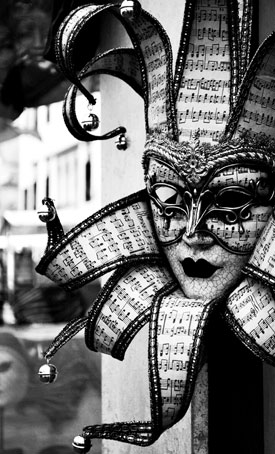
Venetian Masks - Bauta

The Bauta is to be considered the traditional Venitian mask, the one mostly used to cover your features, made in a way that it is still possible to eat and drink without having to take it off. The Bauta is always black, white or gilded, and it is not only a Carnival mask, in the sense that centuries ago it was also used to protect one's identity in different circumstances. It was mandatory all year long for women who went to the theater and forbidden to girls waiting to be married.


The name bauta may come from the German "behüten"(to protect), as well as from "bau" (or "babau"), typical Italian representation of the monster, or bad beast, used by adults to scare children.

The Bauta mask formed part of an entire outfit. This outfit consisted of a Tabbarro which was a veil or a small cloak starting at the neck and covering the shoulders and a tricorn hat. From this the mask protruded to give complete anonymity.

In 18th century, the Bauta had become a standardized society mask and disguise regulated by the Venetian government.It was obligatory to wear it at certain political decision-making events when all citizens were required to act anonymously.

Wednesday, February 8, 2012

Venice Reading Challenge - The Passion

There is no better combination than to read your favorite author while reading for a challenge involving Venice! Does it matter that it is my fourth read of The Passion, by Jeanette Winterson? Not at all. :)


I first read this enchanting novel more than ten years ago and it is still in my top five favorite books. You may surely wonder what is so special about it? Here's a short list:

~ Jeanette's style is incomparable to any other author, dead or alive;
“Perhaps all romance is like that; not a contract between equal parties but an explosion of dreams and desires that can find no outlet in everyday life. Only a drama will do and while the fireworks last the sky is a different colour.”

~ the (love)story that gradually unravels between Henri, Napoleon's cook and Villanelle, the mysterious Venetian:
“In that house, you will find my heart. You must break in, Henri, and get it back for me.'Was she mad? We had been talking figuratively. Her heart was in her body like mine. I tried to explain this to her, but she took my hand and put it against her chest.
Feel for yourself.”


~ the key phrases will follow you long after you finish reading the book and you may find yourself quoting them now and then.
"I'm telling you stories. Trust me."
"You play, you win, you play, you lose. You play. It’s the playing that’s irresistible. What you risk reveals what you value."


~ Venice, described as the "city of mazes", where one can lose one's way, where nothing is certain and everything is unfolding into another thing:
"This is the city of mazes. You may set off from the same place to the same place every day and never go by the same route. If you do so, it will be by mistake. Your bloodhound nose will not serve you here. Your course in compass reading will fail you. Your confident instructions to passers-by will send them to squares they have never heard of, over canals not listed in the notes."

~ magic realism, which gives you the feeling that one day you could live (in) this fairy tale yourself: "Rumour has it that the inhabitants of this city walk on water. That, more bizarre still, their feet are webbed. Not all feet, but the feet of the boatmen whose trade is hereditary."

~ the switch in narrative voice which, if you are not careful, can make you lose yourself between the lines, just like you might lose your way on the small streets of Venice;

~ crossing boundaries and transgression: Villanelle can be as mysterious and provoking as Venice itself.

~ in short,it's a book about loving so/too much: “Whoever it is you fall in love with for the first time, not just love but be in love with, is the one who will always make you angry, the one you can't be logical about.”

Venice will taste, feel and smell even better after you've read The Passion!

Read for the Venice Challenge and the European Reading Challenge

Monday, February 6, 2012

Venitian Masks

It's carnival time in Venice and since we are not there showing off our expensive costumes, we'd better lean a few things about the different masks that appear during Carnevale.

Venetian masks have a long history of protecting their wearer's identity during promiscuous or decadent activities. Made for centuries in Venice, these distinctive masks were formed from papier-mâché and wildly decorated with fur, fabric, gems, or ribbons. Eventually, Venetian masks re-emerged as the emblem of the Carnival.


After the 1100s, the masquerade went through periods of being outlawed by the Catholic Church, especially during holy days. Their policy lead to eventual acceptance when they declared the months between Christmas and Shrove Tuesday free for Venetian mask-attired decadence. This period evolved into Carnival, the pre-Lent celebration meaning "remove meat." Although Carnival lost popularity as Venice's cultural production faltered during the Enlightenment, it was officially reintroduced in 1979.

Drop by soon to discover the types of masks and their meaning :)
Click here or here if you are interested in buying a handmade mask.

Friday, February 3, 2012

Venice - A Unique Mystery


“If you read a lot, nothing is as great as you've imagined. Venice is... Venice is better.” (Fran Lebowitz)

Wednesday, February 1, 2012

VENICE IN FEBRUARY IS HERE!


The amazing reading challenge that I am hosting together with DolceBellezza is finally here and my, the number of books to be enjoyed is so high I had trouble deciding what to read in one of the busiest months of the year, it seems. BUT, struggle aside, I finally decided on four books, hoping to be able to read them all this month. Here they are:


And since Venice is more than the background for an enthralling plot, it is a mystery in itself, this month there will be plenty of posts dedicated to the ever so fascinating SERENISSIMA, so feel free to drop by anytime and don't forget that it's incredibly easy to join us: just read at least one book set in Venice. You can link your participation here.

P.S. Re-reads count, as I am going to read The Passion for the fourth time :)

Sunday, January 29, 2012

Blue Suitcase


There's a enticing story behind every blue suitcase...

Sunday, January 22, 2012

Perfection - Six Word Sum Up

This is a very sad book, but not entirely.


Life: still possible after betrayed love.

Here's a very insightful interview with Julie Metz taken by the New York Times, and the official site for the book.

Friday, January 13, 2012

Nos Separations - David Foenkinos

Most French authors write with a humour and charm that is so typical of them and David Foenkinos is no exception.


"Nos Separations" presents the story of Alice and Fritz and their other relation(ship)s with secondary characters such as Fritz's friend Paul and his lover Virginie, Fritz and his wife Iris or Alice and her husband. The book is more about the two lovers' sad separations rather than their relationship; it is about the constant need to be with the one you love even though you hurt that person and he/she hurt you as well.

"Encore une fois, nous étions dans une ambiance mi-prune mi-pêche (chacun ses expressions), et j'ai pensé que je serais peut-être heureux de passer ces moments sans elle. Depuis des mois, nous vivions collés, dans l'autarcie de notre révélation amoureuse, alors cette première séparation serait sûrement bénéfique."

The writer gives us the chance to see a few of the decisive moments in Alice and Fritz's liaison: we learn how they fell in love, how they quarrelled and how Fritz cheated on Alice. It is with so much ease that Foenkinos presents his lovers' story that you might think their situation is not serious. He even mentions at the beginning of the novel that we might all be cliches. Still, with delicate humour the final separation takes place and we are left with the character's struggles to avoid any place they walked together in Paris and with ironic dictionary definitions in which he as well becomes one.

“Il y a des personnes formidables qu’on rencontre au mauvais moment, et des personnes qui sont formidables parce qu’on les rencontre au bon moment.”

The end is still optimistic. A boy and a girl - Alice's and Fritz's children from different relationships) meet in Pere Lachaise cemetery (read the wonderful book to discover why) and we may think the story can begin once more. maybe with a different, better ending this time :)

Read for: New Authors Challenge and European Reading Challenge (France)

Monday, January 9, 2012

The Marriage Plot - Six Word Sum Up

My third book by Jeffrey Eugenides and definitely my favorite, and one of the best reads of 2011!


Life is about loving and learning.

The New York Times offers a great review here.

Wednesday, January 4, 2012

Rape: A Love Story, by Joyce Carol Oates

My first encounter with Joyce Carol Oates' work has been rather disturbing, since this novella is not something one would truly enjoy reading. As its provocative title suggests, it is about a rape and its effects on the people involved. Still, how can love find its place amidst all that?


The novella brutally starts with: “After she was gang-raped, kicked and beaten and left to die on the floor of the filthy boathouse at Rocky Point Park. After she was dragged into the boathouse by the five drunken guys – unless there were six, or seven – and her twelve-year-old daughter screaming Let us go! Don’t hurt us! Please don’t hurt us! After she had been chased by the guys like a pack of dogs jumping their prey, turning her ankle, losing both her high-heeled sandals on the path beside the lagoon" and we hardly find any time to breathe between pages, bound to go through the ordeals and struggles that the mother and daughter have to face. Teena Maguire together with her 12 year old Bethie chose the shorter way home, on the night of 4th of July, and being the victim of a gang rape, she is now left to regret that she has survived.
The dreadful trial, the shame and the blame that the community casts over them leave the two in the impossibility to move forward, until someone decides to take matters into his own hands. Out of love for Teena and to see justice being done. The book finally takes a positive turn when we see the two characters being avenged. Somehow.
Could things have been different? Was it their destiny? Bethie tries to find an answer:
“There was a final shake of the dice. Another time it might have been averted. When Casey said, ‘Teena, let me drive you two home. Wait a minute, I’ll get the car,’ and your mother thanked him and kissed him on the cheek, telling him not to bother – ‘We want to walk, don’t we, Bethie? It’s a perfect night.’”

It was not a perfect night, but there is hope at the end of the last page.

Read for: Orange in January Challenge and New Authors Challenge

Sunday, January 1, 2012

2012 - It's Dickens Time!


Everybody has heard of Charles Dickens, one of the greatest writers in English literature and I dare say, everybody has read one or more of his works. If not (shame on you!) 2012 is the time to (re)discover him, since the literary world is celebrating 200 years since his birth.
You can find everything about his life here , his works online here or any related event to Dickens 2012 here. Oh, and if you happen to visit London, The Charles Dickens Museum has reopened.
For those pressed for time, the BBC has adapted Dickens' works for the screen and Great Expectations broadcast at the end of 2011 was a total success for the British audience and I loved it, but I still have trouble deciding if it's better or not than the 1998 version...


"That was a memorable day to me, for it made great changes in me. But, it is the same with any life. Imagine one selected day struck out of it, and think how different its course would have been. Pause you who read this, and think for a moment of the long chain of iron or gold, of thorns or flowers, that would never have bound you, but for the formation of the first link on one memorable day."

"I never had one hour's happiness in her society, and yet my mind all round the four-and-twenty hours was harping on the happiness of having her with me unto death."

Suffering has been stronger than all other teaching, and has taught me to understand what your heart used to be. I have been bent and broken, but - I hope - into a better shape."

Quotes taken from Great Expectations.

Thursday, December 22, 2011

Man Walks Into a Room - Six Word Sum Up

I have been planning to read "The History of Love" for more than a year, but it "strangely" happened that I decided to discover Nicole Krauss starting with her first book, "Man Walks Into a Room". I really enjoyed reading it and I can say I found it quite intriguing. You might too.


Losing your memory means finding freedom.

For a more in-depth review, click here.

Saturday, December 17, 2011

The European Reading Challenge


I could not have resisted this challenge, simply because the majority of writers I use to read are European, and there are so many books by them or taking place in Europe that I have planned on reading in 2012. Rose City Reader in hosting this challenge in its first year and I am sure it's not going to be the last :)
As you have figured out, the simple thing that you have to do is read books by European authors or books set in European countries. Easy? To make it challenging, each book must be by a different author and set in a different country. There are five levels of participation and I decided to go with Five Star (Deluxe Entourage), but I will most definitely read more than five, thus qualifying for the Jet Setter Grand Prize!

And since we are speaking of challenges, do not forget to join our own (mine and Bellezza's) VENICE IN FEBRUARY :)

Wednesday, December 14, 2011

Sunday, December 11, 2011

A Friend with a Story

Birgit from The Book Garden has written a book and she has kindly sent me a copy. What a great surprise! I found the story quite uplifting and optimistic. It felt like a rendez-vous between Madonna's children stories and Coelho's "Like a River Flowing", with advice not to give up and never stop following your dreams. Is there something more important in life? We all have our secret garden inside us and it's up to us to rediscover it and its mysteries. Isn't that a simple, yet utterly true message? To have more smiles on your face, click here.


P.S. Dandelions are not just dandelions! :)

Friday, December 9, 2011

The Bigger, the Better? We shall see!


I have decided to join one more challenge, the one hosted by Birgit from The Book Garden, since huge tomes seem to be a problem for me, always postponing them till next year, and next year... and next year. The books in question have to be of more than 700 pages (yup, that's seven hundred) and they should be read sometime next year, meaning 2012 :) There are several levels of the challenge that you can check here. . I decided on the first level, The Chamomile Lover, since it's always better to read more than you planned rather than read less, and the two chunksters are Pamuk's "The Museum of Innocence" and Murakami's "19Q4". So, are there any huge books haunting your shelves?

Thursday, December 1, 2011

What Work of Literature Would You Recommend to Someone Who Doesn't like Literature?


This question is part of the Literary Blog Hop, and it is definitely not an easy one.

If someone doesn't enjoy reading literature, how could you fix this "issue"? A work of literature cannot truly and entirely be revealed unless one finds pleasure in solving its mysteries page by page.
And yet, if there were a book that could turn a non-lover into a passionate lover of literature, that book should be THE BOOK. Is there such a thing? Well, (un)fortunately, not really. Surely, we can recommend our favorite books and that might work, but the true spirit of literature lies in every single book worth reading.
How could anyone not recommend one of Shakespeare's plays (and how difficult it would be to just choose one) or a poem by Wordsworth? They are not among my favorite writers, but can we skip them? Wasn't their writing and our reading that brought us closer to what we now call our favorite writers? How can we say that we like Ionesco if we haven't read any other play? Could we recommend Jeanette Winterson and completely forget about Virginia Woolf? Is that even possible?
To sum up, any work conveying literary value is worth reading in order to savour literature, but one is never enough to fully discover what lies beneath this word: LITERATURE.